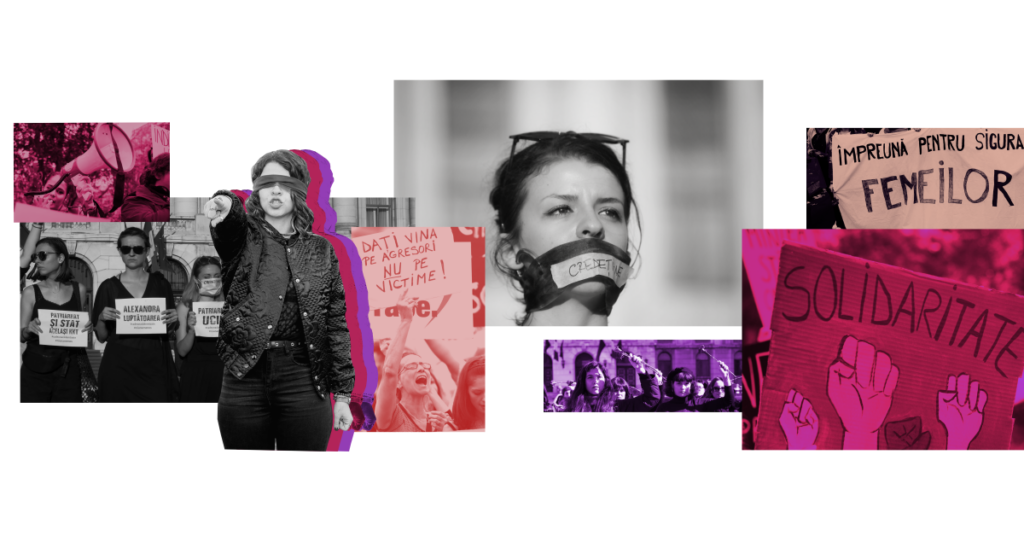
Images from the recent history of the feminist movement in Romania from 2011–2021 have been brought together and are presented to the public in the online exhibition “10 Years of Feminist Actions in the Streets.” The exhibition was launched on the website www.expozitie.ongen.ro by the Front Association as part of the project EGALIS: Gender Equality through Social Change and Education.
The photo-video exhibition recalls marches, protests, and flash mobs for women’s rights in Bucharest, Cluj-Napoca, Sibiu, Iași, Brașov, Timișoara, Giurgiu, Valea Seacă, Alba Iulia, and Târgoviște, through which non-governmental organizations or informal groups drew attention to issues such as domestic violence, sexual harassment and rape, restrictions on the right to abortion, the lack of sexual education in schools, discrimination against Roma women, and violations of women’s rights in other countries.
The exhibition revisits the marches “Together for Women’s Safety,” organized starting in 2015 by the VIF Network to condemn gender-based violence, the feminist protest in front of the Ministry of Internal Affairs in response to the Caracal case, and artistic demonstrations organized on March 8 – International Women’s Day – under titles such as “If One Falls, We All Fall,” “How Much Does a Rape Cost, Your Honors?”, “Feminist Liturgy,” “Misogyny, the Other Pandemic,” as well as flash mobs focused on the right to abortion and sexual education in schools, along with other feminist demonstrations.
The exhibition images are accompanied by the original texts from each action, including calls for solidarity, chants, public statements, moving testimonies, and demands addressed to authorities. Slogans heard in the streets — “Believe Us,” “You Are Not Alone!”, “Solidarity — Let’s Unite!”, “March 8 Is a Day of Struggle!”, and “My Body, My Choice” — are revisited in the exhibition through images and text.
The exhibition captures only part of the feminist civic actions carried out over these 10 years — those that took place in public spaces as street demonstrations. Many other feminist interventions have taken place in communities, schools, workplaces, or during meetings with authorities, and have also taken the form of petitions and public policy proposals. Street actions represent the tip of the iceberg of civic mobilization for women’s rights and gender equality in recent years — the visible part of many other civic efforts to bring issues of discrimination and gender-based violence onto the public agenda. These are complemented by cultural initiatives, increasingly numerous and often at the forefront of feminist demands, in literature, theatre, film, music, contemporary art, and more, as well as research activity in the academic sphere.
The collection of images and texts included in the exhibition was assembled based on the organizers’ own archives and voluntary contributions from other participants, including professional photographers.
The project EGALIS: Gender Equality through Social Change and Education is implemented by the Partnership Center for Equality, in partnership with the Front Association, the AnA Cultural Scientific Society for Feminist Analyses, the Center for Action for Equality and Human Rights (ACTEDO), the PLURAL Association, and the SEXUL vs BARZA Association, with financial support from Active Citizens Fund Romania, a program funded by Iceland, Liechtenstein, and Norway through the EEA Grants 2014–2021. The project aims to generate changes in perception among young people and teachers and to influence decision-makers in developing institutional policies on gender equality through education and awareness activities targeting youth and educators, as well as through watchdog and advocacy actions.
The Active Citizens Fund Romania program is funded through the EEA Grants 2014–2021. The overall objective of the Grants is to reduce economic and social disparities and strengthen bilateral relations between the 15 beneficiary states and the donor states (Iceland, Liechtenstein, and Norway). The program is administered by a consortium composed of the Civil Society Development Foundation, the Partnership Foundation, the Resource Center for Roma Communities, the PACT Foundation, and Frivillighet Norge, acting as Fund Operator designated by the Financial Mechanism Office of the EEA and Norway Grants. Active Citizens Fund Romania aims to strengthen civil society and active citizenship and increase the capacity of vulnerable groups. With a total allocation of €46,000,000, the program supports the long-term development of the sustainability and capacity of the civil society sector, strengthening its role in promoting democratic participation, active citizenship, and human rights, while also reinforcing bilateral relations with the donor states Iceland, Liechtenstein, and Norway.
For more information about the Active Citizens Fund in Romania, please visit www.activecitizensfund.ro.
For more information…